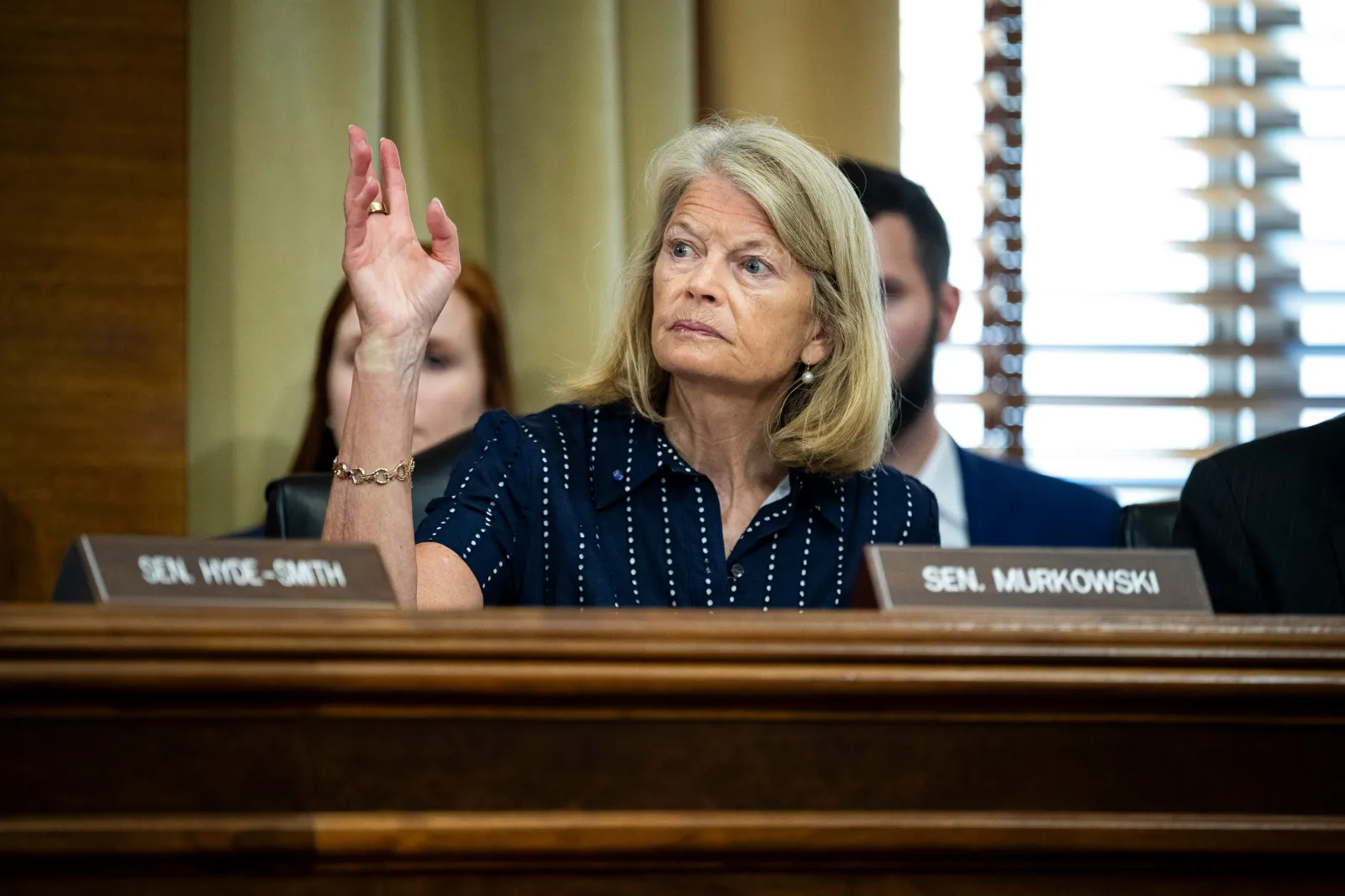
Senator Lisa Murkowski, an Alaskan Republican, detailed her opposition to the GOP-backed Safeguard American Voter Eligibility (SAVE) Act in a Friday opinion piece that was published in the Wall Street Journal, warning that the bill could force some Alaskans to spend more than $1,000 to travel and register to vote in addition to new barriers for rural and Native communities.
Murkowski argues the legislation, a priority of President Donald Trump and many Republicans, would impose requirements that are particularly difficult to meet in Alaska because of its vast geography and limited election infrastructure. Her concerns have also been echoed by some fellow Republicans who have questioned whether the proposal could realistically be implemented before this year’s midterm elections in November.
In her Journal op-ed, Murkowski wrote that she supports measures designed to ensure that only U.S. citizens vote in federal elections but argued the SAVE Act “would have serious negative effects” in Alaska.
The bill would require individuals registering to vote in federal elections to provide documentary proof of U.S. citizenship, and in some cases would require that proof to be presented in person to an election official. Murkowski said the change would create significant obstacles for many eligible voters.
What Did Lisa Murkowski Say About the SAVE Act?
In her op-ed, Murkowski pointed to Alaska’s unique logistical challenges and argued that the legislation “would impose costly new barriers and prevent some, perhaps many, from voting, while also creating chaos before the November elections.”
The bill “would effectively end online voter registration by requiring voters to present documentary proof of U.S. citizenship in person to an election official,” which the senator argues would have a disproportionate effect on Alaskans given there are only a handful of locations in the state that can process the required documentation and that many communities are not connected to the road system. Alaska currently allows eligible residents to register online, a system that is particularly important in a state where many communities are accessible only by air or water.
“Alaska has only six election offices where that requirement could clearly be met. Six places in a state more than twice the size of Texas, where roughly 80% of our communities, and about 20% of our population, aren’t connected by road,” she wrote.
Murkowski added that the legislation could force some Alaskans in remote communities to spend more than $1,000 to register to vote in person, with residents in some parts of the state potentially facing even higher travel and lodging costs to reach an election office. Alaska is by far the nation’s largest state, covering more than twice the land area of Texas.
“Say you are an 18-year-old living in Savoonga, on a remote island in the Bering Sea, who wants to register to vote for the first time. If the SAVE America Act passed, your only option would be to buy a ticket on Bering Air to Nome, which runs about $780 round-trip,” the GOP senator wrote. “A night at the Aurora Inn would be more than $300. So, not counting food and local transportation, it would cost more than $1,000 just to register to vote.”

She also pointed out that Alaska Native voters and older residents without readily available birth certificates could encounter additional difficulties proving eligibility under the bill’s requirements. Alaska has one of the nation’s largest Indigenous populations, with roughly 15 percent of residents identifying as American Indian or Alaska Native.
The Alaskan senator has spoken out against the legislation before and voted against it in February. At that time, she said the proposal undermined states’ constitutional authority to regulate the administration of federal elections.
“Once again, I do not support these efforts,” the senator wrote in an X post in February. “Not only does the U.S. Constitution clearly provide states the authority to regulate the ‘times, places, and manner’ of holding federal elections, but one-size-fits-all mandates from Washington, D.C., seldom work in places like Alaska.”
She said earlier this year, “I support voter ID– but oppose the SAVE Act.”
What Is the SAVE Act?
The SAVE Act would require individuals to provide documentary proof of U.S. citizenship—such as a passport, birth certificate or naturalization papers—when registering to vote in federal elections. Supporters say the measure would strengthen election security, while opponents warn it could create barriers for eligible voters who lack ready access to those documents.
Trump has continually urged Congress to pass the SAVE Act, at times saying he would withhold his signature from other legislation until lawmakers advance the measure. In his Thursday night address in which he spoke about election security, he urged lawmakers to approve the measure, arguing it is necessary to protect the integrity of U.S. elections. “This crisis of election security demands that Congress must pass the SAVE America Act,” he said. “How easy is that to do? Unless you want to cheat.”
Supporters, which include some Republican lawmakers, argue the act is needed to ensure election integrity and prevent noncitizen voting—an extremely rare occurrence—according to 2025 research by the Center for Election Innovation and Research.
Representative Ben Cline, a Virginia Republican, said in a Thursday X post, “Passing the SAVE America Act is more important than ever. The American people deserve the security of knowing their elections are safe from foreign interference, and the SAVE America Act ensures our elections are for Americans, by Americans.”
The debate over the legislation centers less on whether noncitizens should be allowed to vote—which is already illegal—and more on whether requiring documentary proof of citizenship would prevent enough unlawful voting to justify potential burdens on eligible voters.
Those against the act, largely Democrats and voting rights advocates, warn that the requirements could create barriers for eligible voters, particularly those who lack easy access to citizenship documents.
“If passed, the SAVE Act would intentionally keep millions of eligible voters from casting a ballot,” Hannah Fried, co-founder and chief executive officer of All Voting is Local, previously told Newsweek. “Likewise, millions of women whose married names aren’t on their birth certificates or passports would face extra steps just to vote.”
Research published by the Brennan Center for Justice, VoteRiders, the Center for Democracy and Civic Engagement at the University of Maryland and Public Wise in June 2024 found that an estimated 21.3 million U.S. citizens of voting age—about 9 percent of the eligible voting-age population—do not have documentary proof of citizenship, such as a U.S. passport, birth certificate or naturalization certificate, readily available. The study also found that at least 3.8 million citizens do not have those documents at all, often because they were lost, stolen or destroyed.
Has the SAVE Act Passed the Senate?
Republicans hold narrow majorities in both chambers of Congress. Although the House passed a version of the SAVE Act in February, the measure has struggled to gain enough support in the Senate, where most legislation must clear a 60-vote threshold to advance.
In June, Senate Republicans attempted to attach the SAVE Act to an immigration funding package, but the effort fell short of the votes needed to advance. Representative Chip Roy, a Texas Republican and the lead House sponsor, said in an X post Thursday, “President Trump is exactly right. We need to pass Rep. Roy’s SAVE America Act. The House has passed it FOUR times now. The Senate must act. Inaction is not an option.”
Earlier this year, GOP Senators Thom Tillis, Susan Collins, and Mitch McConnell voted with Murkowski and Democrats to strike down an effort to attach the bill to the nearly $70 billion package geared toward funding U.S. Immigration and Customs Enforcement (ICE) and Border Patrol.
While some GOP members and Trump are pushing for the legislation to be passed before the midterms, some experts and legislators warn it’s not feasible.
Senate Minority Leader Chuck Schumer, a New York Democrat, said in a Thursday X post that the Act won’t pass. “Not now. Not ever. The SAVE Act is dead on arrival in the United States Senate,” he wrote.
While Senator Mike Lee, a Utah Republican and a lead sponsor, has said that if the bill is passed soon, it could be implemented for the midterms, Tillis has told reporters, “Do y’all have any idea how many governmental entities have to implement these changes before November? More than 10,000. … If we had passed this last year, it couldn’t have been implemented in time.”
Trump and his allies continue to push for the measure to clear both chambers of Congress before the 2026 midterms, which are over three months away.
Contact Newsweek editors for this story: Steve Mollman and Anthony Murray.