Pakistani dramas have long enjoyed a loyal audience in India. For many Indian viewers, these shows are a reprieve from the “over-the-top” daily soaps that stretch for decades with illogical time leaps. So when Meri Zindagi Hai Tu, starring Hania Aamir and Bilal Abbas, premiered in November 2025, it quickly became a phenomenon among Indian viewers. The chemistry between the lead pair and the storyline created a frenzy, with fans eagerly waiting for each episode.
However, as Meri Zindagi Hai Tu enters its later stages, a familiar fatigue has set in. Recent episodes have begun to test audience patience. Many viewers now feel that the story is being stretched unnecessarily, weighed down by side plots that fail to add to the main narrative. Online discussions are full of viewers frustrated that the story keeps circling the same issues without moving toward resolution.

But while the masses are busy debating the pacing of a blockbuster, another Pakistani drama quietly arrived in January 2026, and deserves far more attention than it has received.
About Aik Aur Pakeezah
Aik Aur Pakeezah entered with barely a whisper in Indian entertainment spaces. No viral chemistry reels. No trending hashtags. Written by Bee Gul and directed by Kashif Nisar, the show stars Sehar Khan, Nameer Khan, Amna Ilyas, Gohar Rasheed, Noor-ul-Hassan and Nadia Afgan.
Sixteen episodes in, it remains criminally under-discussed outside Pakistan’s own viewing circles. Aik Aur Pakeezah is built around the premise of cybercrime and the destruction it can unleash, particularly on women, in a society where a private moment, once made public, becomes a lifelong verdict. But what makes the show stand out is not just the subject. It is the quiet, uncomfortable honesty with which it explores trauma, patriarchy, and social hypocrisy.
Pakeezah, played with extraordinary control by Sehar Khan, is a vivacious, joyful young woman studying law. She is in love with Faraz, an engineer. They speak over the phone, fall deeper in love, and one day decide to meet. A simple meeting is turned into a living nightmare when a neighbor records them at gunpoint and later circulates the video.
In a society obsessed with honour, the consequences are immediate and brutal. Pakeezah and Faraz are forced into marriage, and suddenly two young people who were simply in love find themselves trying to survive a scandal that refuses to let them breathe. What follows is not just the story of a viral video. It is the story of how an entire ecosystem reacts to it.
Story continues below this ad
ALSO READ: Vijay makes public appearance with Trisha days after wife Sangeetha files for divorce, watch video
Trauma, told differently
The brilliance of Bee Gul’s writing lies in how she differentiates the trauma of each character.
Pakeezah and Faraz don’t have the luxury of “healing.” Forced into marriage and forced to hide from public recognition, they are in survival mode. There is no room to breathe, no space to grieve. Trauma, the show understands, does not wait politely for you to process it. It arrives alongside rent that needs to be paid and food that needs to be cooked.
Their frustration often spills into arguments with each other. She has lost contact with her entire family. Faraz, by contrast, manages stolen visits to his. She sees this. She feels the unfairness of it, not because she begrudges him, but because she knows why. She is a girl. His mistake is forgivable. Hers, in the eyes of the world, is not.
Story continues below this ad
In a standout scene, the two talk past each other rather than to each other, both drowning in their own internal noise, neither truly hearing the other.
But the trauma is not limited to them.
Pakeezah’s mother, played brilliantly by Nadia Afgan, carries her trauma in the way many mothers do: by refusing to acknowledge it. Her trauma is manifested through “functional denial”—she talks about daily chores and her daughter with a normalcy, as if her brain has simply refused to process the tragedy. She fills the silence with the ordinary because the extraordinary is simply too heavy to hold.
Pakeezah’s father retreats into his shell. Her elder brother does the same. Her younger brother, consumed by a rage, simply leaves. Each person breaks differently.
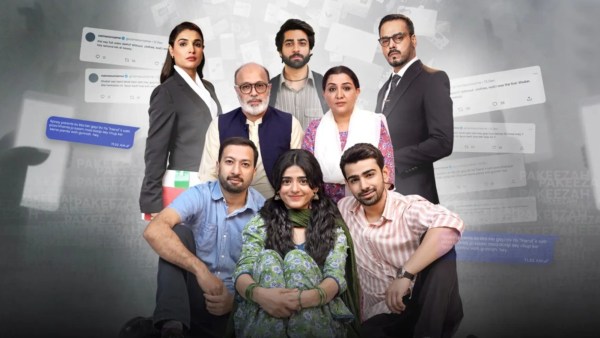 A still from Aik Aur Pakeezah. (Photo: YouTube/Drama Baazar)
Patriarchy laid bare
Aik Aur Pakeezah portrays patriarchy as the very structure of the world these characters live in – so deeply embedded that they don’t notice it anymore, including its protagonist.
Story continues below this ad
Pakeezah mentions, almost in passing, that her brother was given the responsibility to beat her after the video came out. She says it without outrage, casually as simply what happened.
Pakeezah’s mother believes that girls who wear pants and shirts are “too forward” and therefore not to be trusted.
People casually suggesting that Pakeezah should have been killed, that her father would be well within his rights to kill her, that her father should have beaten her and be strict towards her. From neighbours, to co-workers to investigating officers, everyone had these words.
The perpetrator, the man who held a gun and recorded the video, celebrates his wedding with pomp, distributes sweets to the same neighbourhood. He justifies his actions by invoking his role as the guardian of the mohalla’s honour.
Story continues below this ad
When Pakeezah files a case, investigation and legal process becomes itself an extension of that patriarchy, every step accompanied by ridicule, by moral interrogation.
The Arc of realisation
Another strength of the show is how it builds character arcs through moments of realisation. These moments arrive in this show as quiet, internal shifts.
Pakeezah’s own turning point comes during a visit to her parents’ home. Her mother is desperate to have her gone before the men return. Outside, the neighbourhood is celebrating the wedding of the very man who ruined her life.
He lives freely. She cannot even stay in her own house and hides when her brother comes. That moment pushes her to make a decision, she decides she will not hide anymore. She will file a case.
Story continues below this ad
When she visits Saman (Amna Ilyas), the lawyer and mentor she knew during her law studies, Pakeezah arrives without expectation, reintroducing herself, unsure whether Saman even remembers her. And Saman does remember. She lights up. She hugs her and asks where she has been, says she has been looking for her. That moment, the shock on Pakeezah that someone still cares breaks her completely. She cries, for the first time, like a child. Sehar Khan’s acting in this scene is beyond praise.
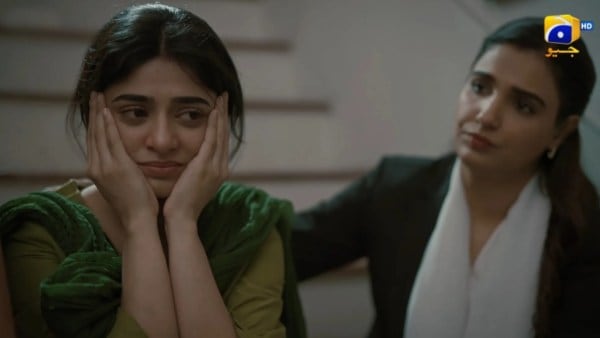 A still from Aik Aur Pakeezah. (Photo: YouTube/Drama Baazar)
Faraz (played by Nameer Khan) resists Pakeezah’s decision to file the case, certain that public memory will fade and they can eventually slip back into ordinary life. With time, Faraz understands that there is no exit from this.
Perhaps the most satisfying arc belongs to Pakeezah’s younger brother. Initially, he believes the only way to restore honour is violence. He wants to kill either the culprit or his own sister. Unable to face the shame, he leaves town.
He returns to find his father attempting suicide. And then he witnesses the perpetrator at their doorstep, distributing wedding sweets, being received politely by a family that sits in helpless silence.
Something shifts.
He goes to his sister and tells her not to withdraw the case — even after learning about their father’s suicide attempt. He says he is with her. The dialogue in that scene is written and performed with such tenderness, that it is difficult to watch without feeling the weight of it in your chest.
Story continues below this ad
Her father’s realisation, too, is earned over time. After Pakeezah files the case, he is devastated, not for her, but for the renewed public scrutiny. He tries to kill himself. But when he begins to hear people around him talking about her, telling him how he had the patience to not kill her. He realises that the silence is just consuming him and he goes ahead and submits his phone for investigation, preparing for the fight ahead.
The mother’s evolution comes through a single encounter with the perpetrator, who arrives at her home and threatens her indirectly. His one dialogue changes something in her. The next day, she makes sure that people know that her daughter has filed a case. Her love for Pakeezah is no longer something she keeps hidden in fear.
Love in the margins
It would be easy to overlook the love story in all of this. Pakeezah and Faraz are not allowed the luxury of a love story anymore. And yet it is there, breathing in the margins of every scene they share.
The tenderness that exists in the space between two people who have survived something enormous together and do not quite know what they are to each other now. It is not a typical love story. It is something more fragile and more real — love that has not been destroyed by what happened, but that has been forced to find new, quieter forms of expression.
Story continues below this ad
Why Aik Aur Pakeezah needs to be watched
Sixteen episodes later, Aik Aur Pakeezah has quietly become one of the most layered Pakistani dramas in recent times.
But why aren’t we talking about this more? Why is a show this beautifully made flying largely beneath the radar?
That says something about the choices we make as an audience. Romance translates quickly. The shorthand of a love story crosses borders easily. A drama about cybercrime, patriarchy, trauma, and institutional failure demands more attention, more patience without the comfort of a romantic resolution. It forces you to pause, contemplate, and question the very fabric of our social structures
Aik Aur Pakeezah refuses to make that easy for you. Which is, precisely, why it needs to be watched.