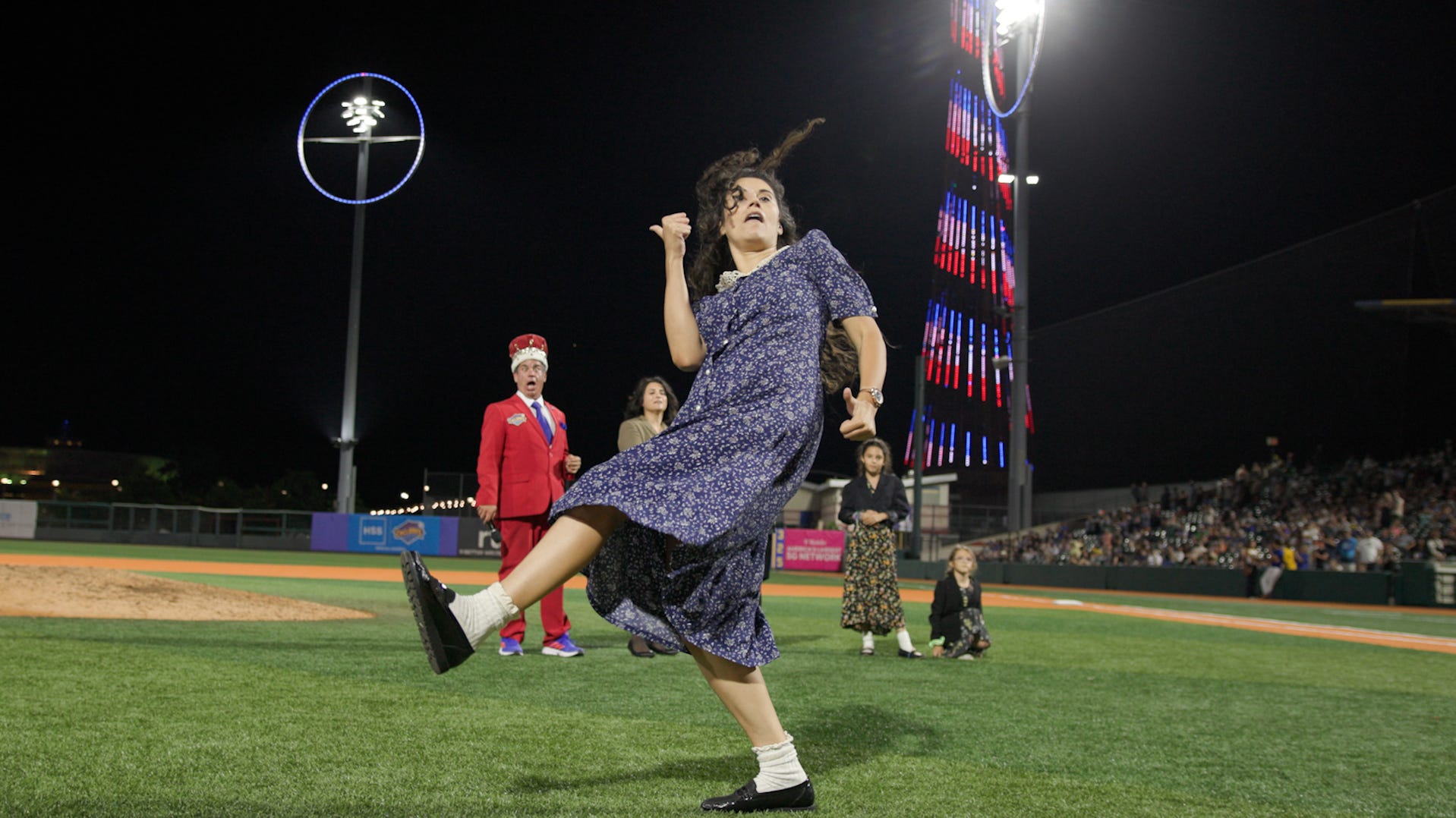

See which ‘Seinfeld’ fan won Brooklyn Cyclones’ Elaine Dance Contest
The Brookyln Cyclones, a minor league baseball town, hosted an Elaine Dance Contest at their annual “Seinfeld” night.
Sick of all the tinsel, wrapping paper and holiday cheer? Festivus may be right for you.
Born from the sitcom “Seinfeld” and embraced as a quirky antidote to holiday excess, Festivus is the tongue-in-cheek December tradition that swaps tinsel for an aluminum pole and cheer for “airing of grievances.”
In the 1997 episode, George Costanza (Jason Alexander) talks about the wacky, anti-Christmas holiday invented by his father, Frank Costanza (Jerry Stiller), called “Festivus.”
Frank later explains that the idea for an anti-commercial winter holiday came about after engaging in a fight with another parent over a toy his son wanted, a la “Jingle All the Way.”
“Out of that, a new holiday was born. A Festivus for the rest of us,” Frank tells Kramer (Michael Richards).
What began as a sitcom bit quickly grew into something far more enduring – a holiday that people across the U.S. not only recognize by name, but celebrate.
What is Festivus?
Festivus is a fictional holiday created on the sitcom “Seinfeld” as a secular, anti-consumerist response to Christmas. Known for the catchphrase “Festivus for the rest of us,” it takes place on Dec. 23 and offers a festive reprieve for those disillusioned by the religious or materialistic aspects of a modern American Christmas.
Festivus traditions are the antithesis of more familiar holiday practices, according to the official Festivus website. Instead of a decorated tree, a plain aluminum pole is put up for display. In place of giving thanks after a holiday feast, participants gather after a subpar meal for the “airing of grievances,” during which they share how they disappointed each other in the past year.
And the feat of strength – well, that one seems to lack a more traditional counterpart. But a good wrestling match rounds the holiday out.
What episode of ‘Seinfeld’ is Festivus in?
Festivus appears in Season 9, Episode 10, of “Seinfeld” titled “The Strike.” It originally aired on Dec. 18, 1997.
“Seinfeld” is available to stream on Netflix or rent on Amazon Prime Video.
What is the story behind Festivus?
Festivus was invented for a “Seinfeld” episode. It was the brainchild of writer Dan O’Keefe, based on a tradition started by his father, Daniel O’Keefe, according to his 2005 book, “The Real Festivus.” When O’Keefe was a child, his father conceived of a secular holiday filled with wacky traditions to escape Christmas consumerism. The family first celebrated it around 1966 based on the anniversary of Daniel’s first date with his future wife, Deborah, according to a blog by the Library of Congress.
Some of the traditions depicted on the show, like a wrestling match dubbed the “feat of strength,” were based on real-life, O’Keefe told the New York Times. The family holiday was less organized and stranger in reality, O’Keefe said, often occurring on random days and featuring practices without a clear purpose, like keeping a clock in a bag.
Unfortunately, the Festivus origin story has a darker side, as well.
“I mean this in the nicest way possible: My father was an undiagnosed bipolar, severe alcoholic who nonetheless was extremely high-functioning,” O’Keefe explained in an interview with the Daily Beast.
“We never knew when Festivus was. It was a floating holiday,” he told The Journal News. “It appeared whenever my dad felt like it. You came home from school and there were weird things pinned to the walls, strange decorations, strange music playing and strange things being said, and it was on.”
Do people celebrate Festivus?
What began as one family’s unique celebration has become something of an enduring folk holiday still celebrated in pop culture.
Multiple instruction manuals on fusing Festivus with other holidays like Passover have been published. Community events featuring the three main pillars – the pole, the airing of grievances and the feat of strength – have also popped up over the years.
Dinner is likewise central to the celebration, but what constitutes a “traditional” Festivus dinner is unclear, as it was never explicitly outlined in the episode. The characters sit down to what appears to be a meatloaf in the original episode, but the spread also been interpreted as being a spaghetti dinner.
Festivus has been recognized by politicians and even landed in a museum after Wisconsin Gov. Jim Doyle displayed a Festivus pole in his executive residence in 2005, which is now on display in the Wisconsin Historical Museum.
Senator Rand Paul of Kentucky has also been marking the holiday since 2013, eventually making the “Festivus Report” that calls out what he calls “wasteful” government spending.
Contributing: Bebe Hodges, the Cincinnati Enquirer