Freedom fighter and towering figure of the Communist movement, R. Nallakannu, passed away in Chennai on Wednesday (February 25, 2026). He was 101 years old. He was ailing for some time and was undergoing treatment at the Rajiv Gandhi Government General Hospital, where he breathed his last.
Fondly known as RNK in party circles, he chose to remain with the CPI when the Communist movement in India split in 1964 following the Indo-China war. He served as Tamil Nadu State secretary of the CPI for three tenures since 1992.
A dedicated field worker and organisational man, Nallakannu led a tireless campaign against the sand mafia that was illegally mining sand from the Thamirabarani river basin. In 2010, he filed a Public Interest Litigation (PIL) petition and personally argued the case in the Madras High Court, securing a stay order against sand mining.
In Pictures: Remembering CPI leader R. Nallakannu (1925-2026)
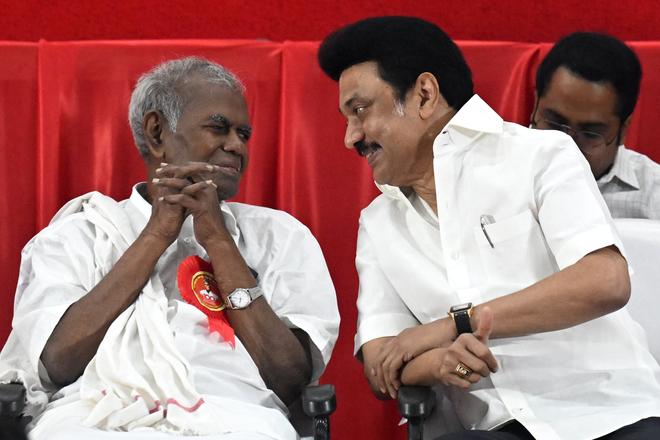
Tamil Nadu Chief Minister M.K. Stalin speaks to veteran CPI leader R. Nallakannu during an event organised to celebrate the latter’s 100th birthday in Chennai on December 29, 2024.
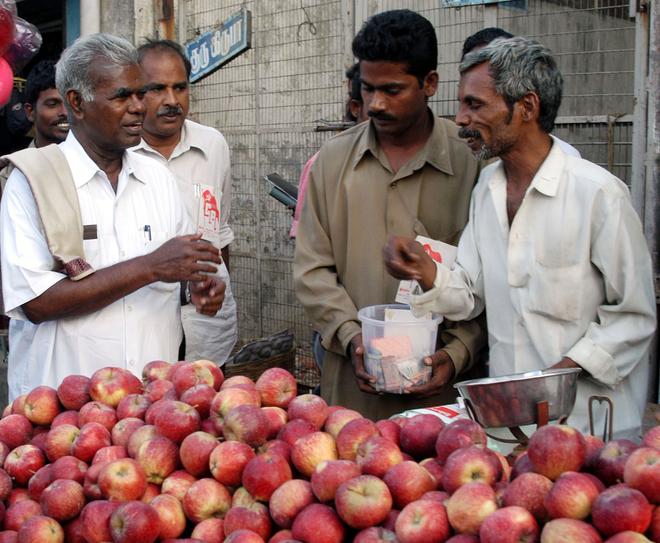
Then CPI state secretary R. Nallakannu collecting election fund from the public at Kodambakkam in Chennai on December 9, 2003.
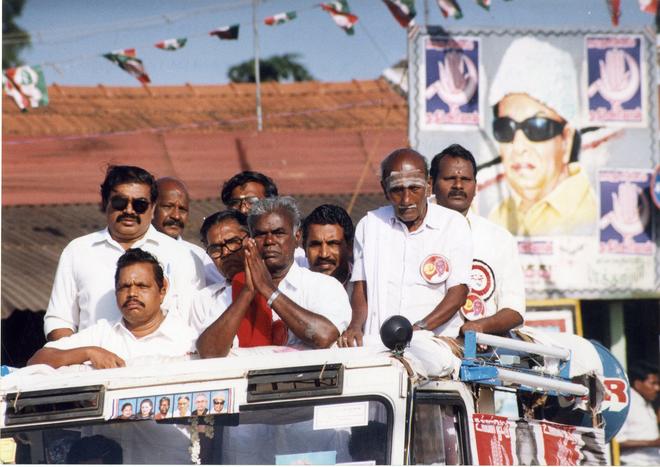
Then CPI candidate for Coimbatore Lok Sabha seat R. Nallakannu campaigning in Coimbatore in 1999. During the General Election that year, he lost to then BJP leader C.P. Radhakrishnan who is now the Vice-President of India
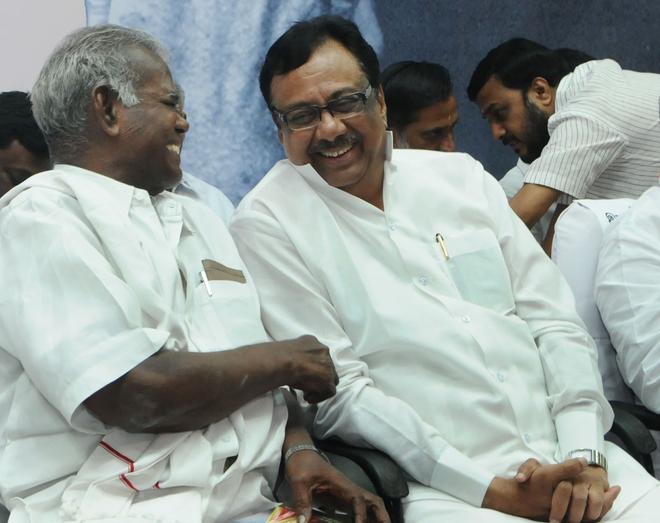
Then Tamil Nadu Congress Committee president E.V.K.S. Elangovan and CPI Leader R. Nallakanu share a light moment at Sathyamurthy Bhavan in Chennai on December 1, 2014.
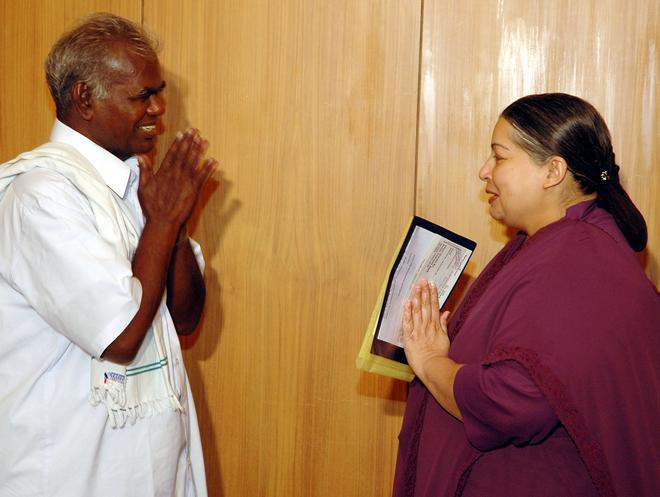
Then CPI State secretary R. Nallakannu with the then Tamil Nadu Chief Minister J. Jayalalithaa at the Secretariat in Chennai on January 13, 2005.
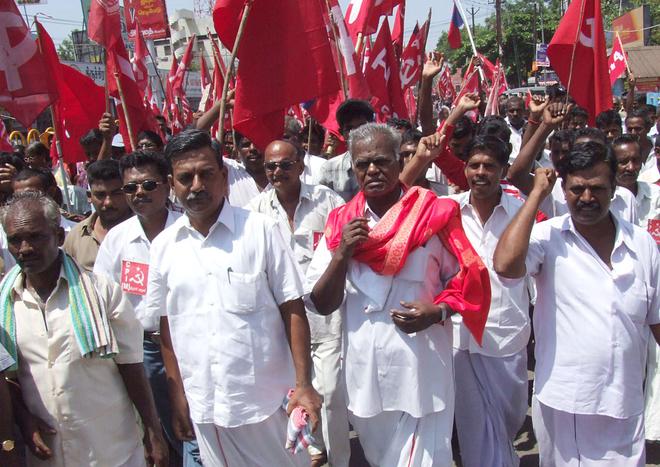
Communist Party of India (CPI) leader R. Nallakannu during a protest against the hike in fuel prices in Tiruchi on June 13, 2006.
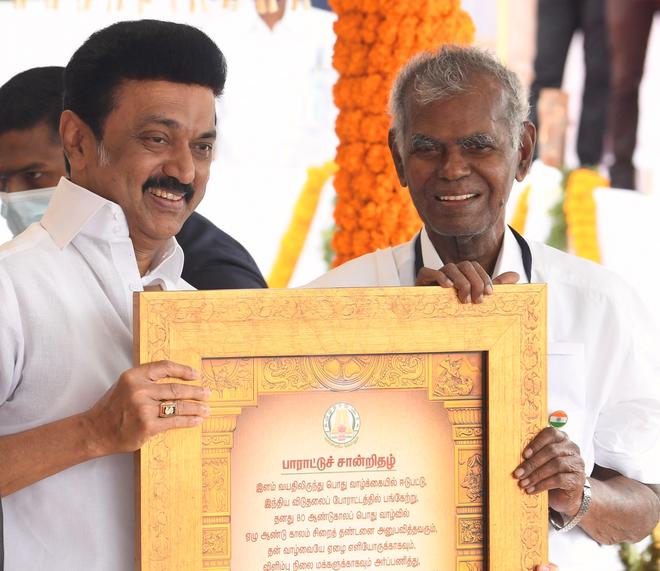
Tamil Nadu Chief Minister M.K. Stalin giving away the ‘Thagaisal Thamizhar’ award to CPI leader R. Nallakannu during the 75th Independence Day celebrations held at Chennai on August 15, 2022. Nallakannu donated the award’s cash component of ₹10 lakh to the Tamil Nadu Chief Minister’s Public Relief Fund along with his additional contribution of ₹5,000.
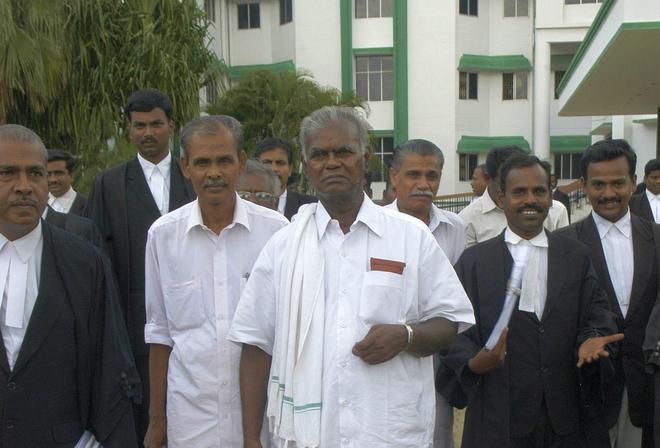
Communist Party of India leader R. Nallakannu coming out of the Madurai Bench of Madras High Court Bench on September 27, 2010 after arguing a PIL relating to sand quarrying in Thamirabarani river.
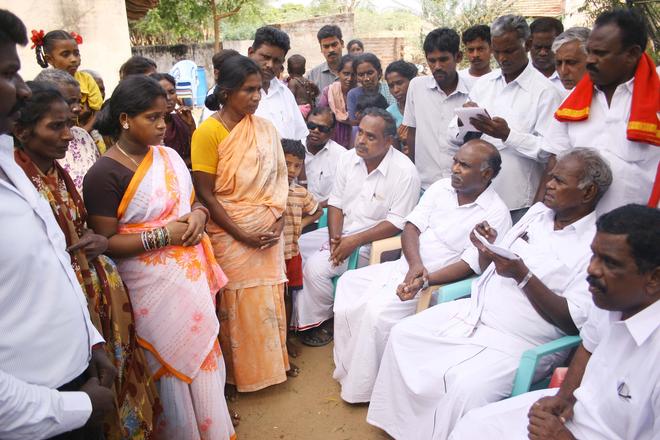
R. Nallakannu (second from right), senior leader of Communist Party of India, enquiring about the Paramakudi firing incident at Manjure village in Ramanathapuram district on August 17, 2011.
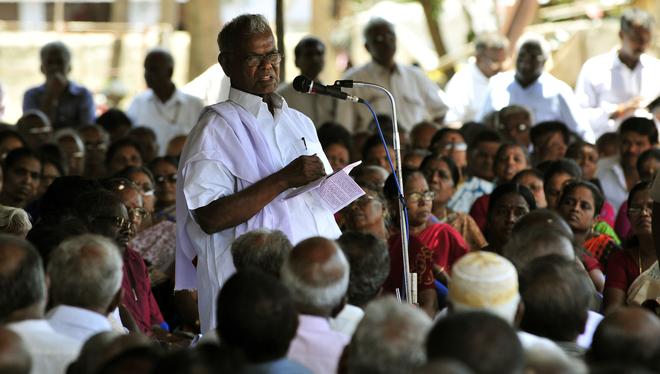
CPI leader R. Nallakannu addressing during a relay fast demanding a service road along Tiruchi-Thanjavur highway in Tiruchi on July 20, 2017.
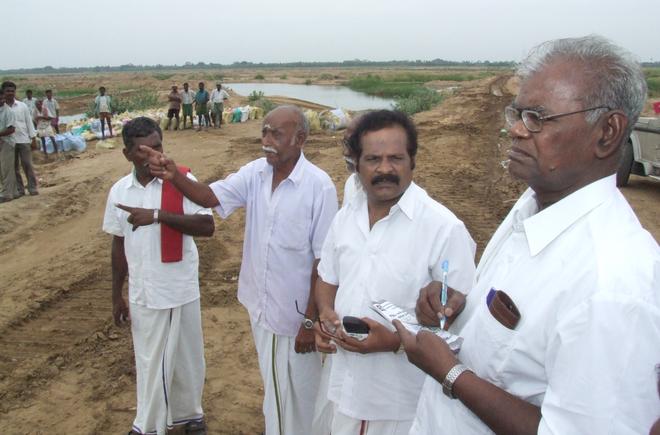
R. Nallakannu, CPI leader, listening to farmers and residents at a sand quarry on the banks of the Coleroon near Anbil in Tiruchi district on August 26, 2011.
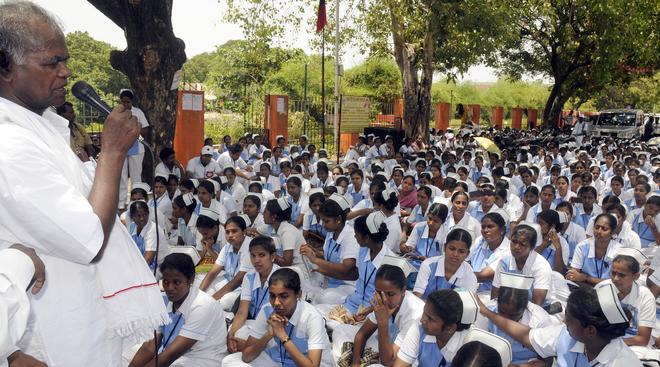
Communist Party of India leader R. Nallakannu addressing the members of the Vijaya Hospital Nurses’ Union during their protest in Chennai June 3, 2012
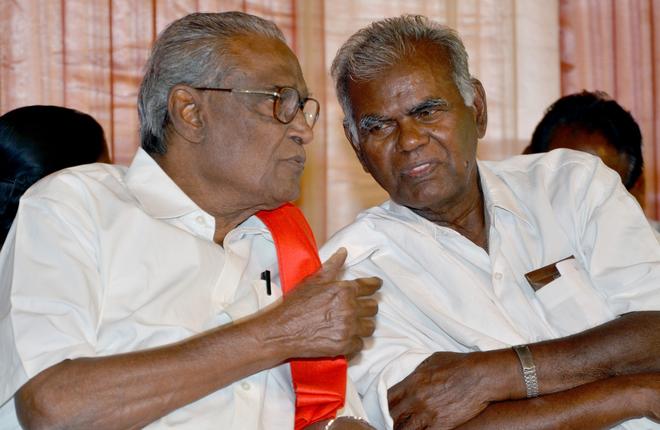
CPI leaders T. Pandian (left) and R. Nallakannu (right) at the State conference against caste clashes, at Salem in Tamil Nadu on January 8, 2013.
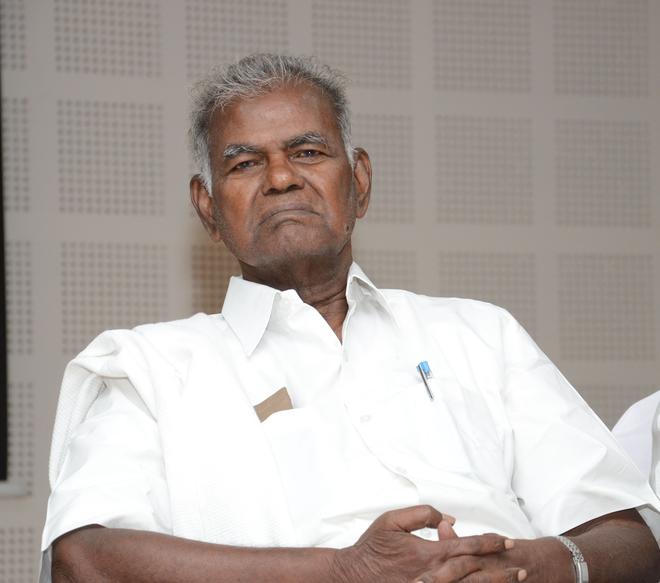
R. Nallakannu, senior CPI leader at Madurai on March 12, 2015.
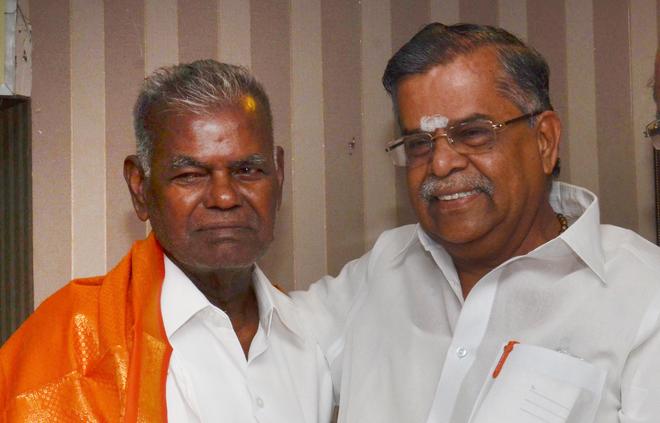
R. Nallakannu with former BJP state president La. Ganesan on December 20, 2014
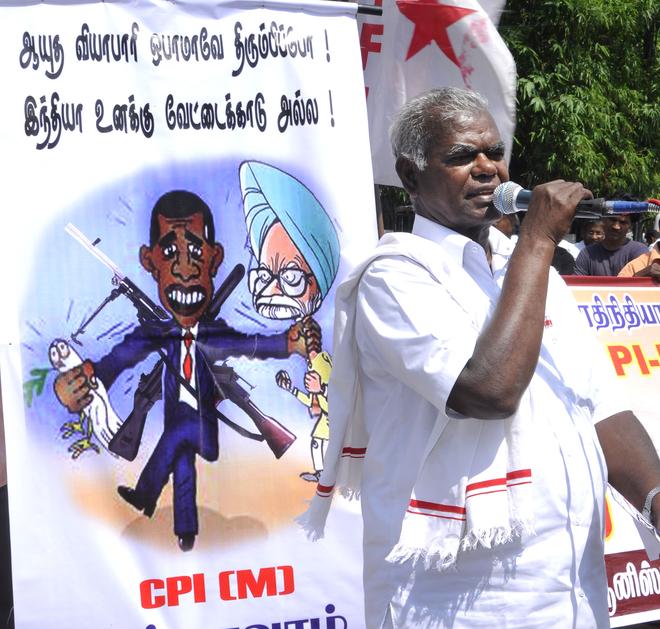
CPI leader R. Nallakannu addressing at a protest demonstration against the US policies, during U.S. President Barack Obama’s visit to India, near Panagal building in Chennai on November 8, 2010.
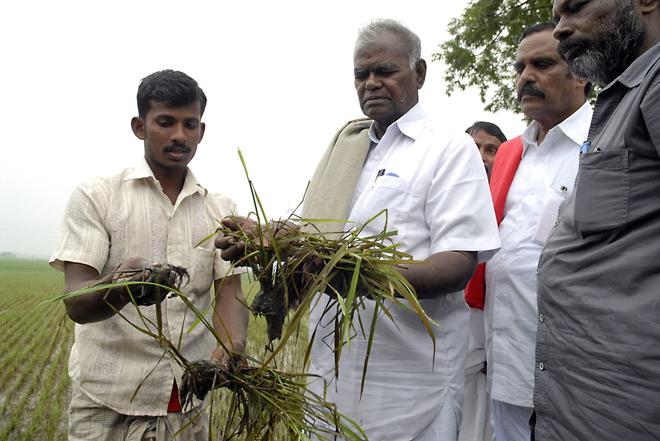
R. Nallakannu, leader of Communist Party of India (CPI), looking at the damaged paddy in the rain-affected areas at Arasur in Thanjavur district on December 5, 2010.
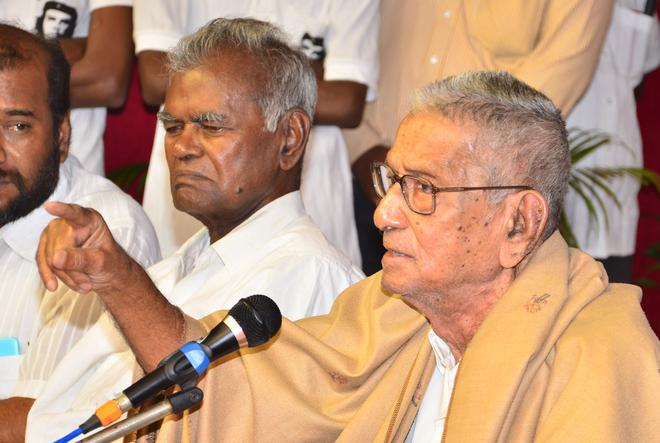
CPI(M) leader N. Sankaraiah (right) addressing State-level conference of the Democratic Youth Federation of India (DYFI) in Dindigul on December 31, 2015, in the presence of veteran CPI leader R. Nallakannu.
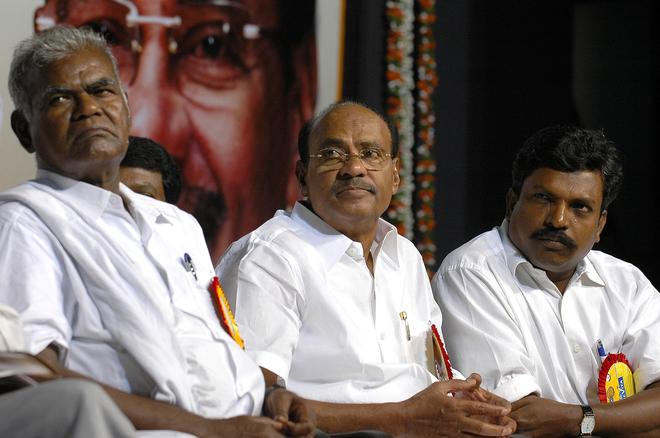
PMK founder S. Ramadoss (centre) with CPI leader R. Nallakannu (left) and Viduthlai Chiruthaigal Katchi leader Thol. Thirumavalavan at a function in Chennai on April 27, 2008.
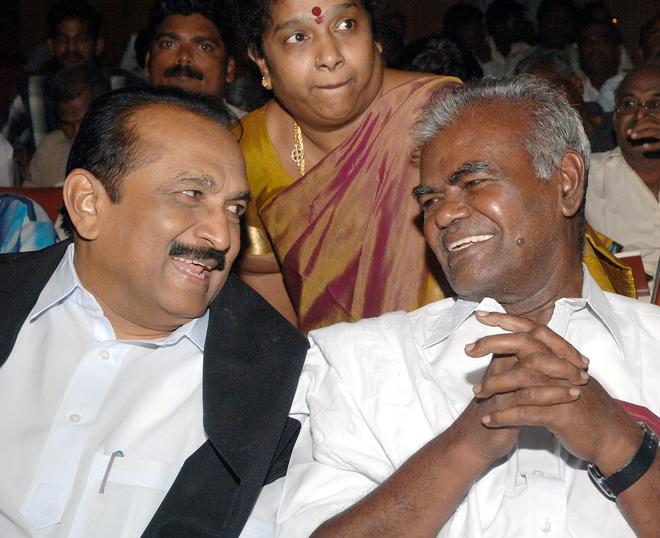
MDMK general secretary Vaiko (left) and CPI leader R. Nallakannu at a book release function in Chennai on May 2, 2008
1/3
Soft-spoken and affable, RNK embodied the values of sacrifice, idealism, and unwavering commitment to the Communist movement and social justice. He shared with leaders such as Jeeva and K. Balathandayutham a love for the poems of national poet Subramania Bharati and the hymns of the Azhwars, particularly Andal and Nammazhwar, appreciating their poetic beauty.
Police torture
RNK was sentenced to life imprisonment in the Nellai Conspiracy Case, along with K. Balathandayutham, P. Manikkam, I. Mayandibharathi, and many others. He also spent many years underground during periods when the Communist Party was banned — first by the British, and later by the Congress government led by Jawaharlal Nehru. He endured severe police brutality; he was unable to grow a moustache thereafter, as a police officer had singed his upper lip with a cigarette butt.
“I was hiding in a friend’s house when the police arrested me. After securing some bombs, they tied my hands and beat me. But I refused to reveal the names of Communist leaders,” he said in an interview, recalling the torture he faced.
Born in 1925 in Srivaikundam, Thoothukudi district, RNK joined the freedom movement as a schoolboy, in a region that was a nerve centre of the independence struggle, nurtured by V.O. Chidambaram, who ran the Swadeshi Steam Navigation Company (SSNC).

“Political leaders would travel to Thoothukudi through my native town of Srivaikundam. I would join the local leaders in organising meetings. You should have heard Pappankulam Chockalingam speak about the Jallianwala Bagh massacre — the entire crowd would weep uncontrollably. Though I was active, I was not allowed to participate in the individual Satyagraha or Quit India movements due to my age,” he recalled in a 2019 interview with The Hindu.
After completing his schooling at Coronation School in Srivaikundam, he joined MDT Hindu College in Tirunelveli. “It was there I came into contact with the writer TMC Raghunathan and raised ₹400 for the Bharathi Memorial in Ettayapuram,” he told Tamil writer Mana in an interview.
Dhoti, towel, and Communist party
RNK joined the Communist Party at the age of 18 and worked closely with P. Srinivasa Rao, who led the agrarian movement in Tamil Nadu. His exposure to the trade union movement in Harvey Mills, Thoothukudi, and his reading of works by Tamil scholar and trade unionist Thiru.Vi. Kalyanasundaram prepared him to commit fully to the Communist movement. “My father wanted me to take a job and lead a normal life. But I simply left home with a dhoti and towel and became a full-time worker of the Communist Party,” he said in the interview.
RNK fought against the exploitation of farm workers by Shaivaite and Vaishnavite Mutts. When he attempted to enter streets forbidden to oppressed communities, he was overpowered, tied to a post, and beaten.
Nellai Conspiracy case
In 1949, he was arrested in the Nellai Conspiracy Case, which alleged that Communists conspired to overthrow Jawaharlal Nehru’s government. He was released in 1956. “The cell doors would be opened briefly in the morning for us to relieve ourselves. The rest of the day was spent in the cell with a pot to urinate in,” he once recalled.
RNK was deeply troubled by the emergence of the RSS-BJP in the Indian political landscape and always expressed concern over the undermining of public sector undertakings and trade unions.
He was also in favour of unification of the Communist parties. “The CPI and the CPI(M) should consider unification. It may not happen overnight, since many decades have passed since the Communist movement split. Only the Communist parties can bring together secular forces against the communal BJP and the Hindutva forces, and halt their march,” he once told The Hindu.
Vice-President’s tribute
A tribute by Vice-President C.P. Radhakrishnan, who won against RNK in the 1999 Lok Sabha elections from the Coimbatore constituency as a BJP candidate, speaks volumes about the Communist leader’s character. “I was actually upset that a dignified leader like him could not win the election. The time of victory need not always be a time for celebration. It was a time when I felt that victory could also bring deep pain,” wrote Mr. Radhakrishnan in a book on RNK, Aravazhvin Adayalam, published by The Hindu Tamil Thisai.
Nallakannu won Thagaisal Tamizhar award of the government in 2022. But he contributed the prize money ₹10 lakh to Chief Minister Relief Fund along with his contribution of ₹5,000
Family
He was married to Ranjitham, daughter of a local communist leader, Annasamy, who incidentally was killed during the 1995 caste riots in the southern districts of Tamil Nadu. One of his daughters, Andal, is a doctor, whilst another daughter, Kasi Bharathi, reflects a combination of names — Kaisina Vendan, the presiding deity of Puliamkulam, and Bharathi.
‘Thagaisal Thamizhar’ award
On August 15, 2022, Tamil Nadu Chief Minister M.K. Stalin presented the ‘Thagaisal Thamizhar’ award to the CPI leader during the 75th Independence Day celebrations held at Chennai. Nallakannu donated the award’s cash component of ₹10 lakh to the Tamil Nadu Chief Minister’s Public Relief Fund, along with his additional contribution of ₹5,000.
Published – February 25, 2026 02:54 pm IST