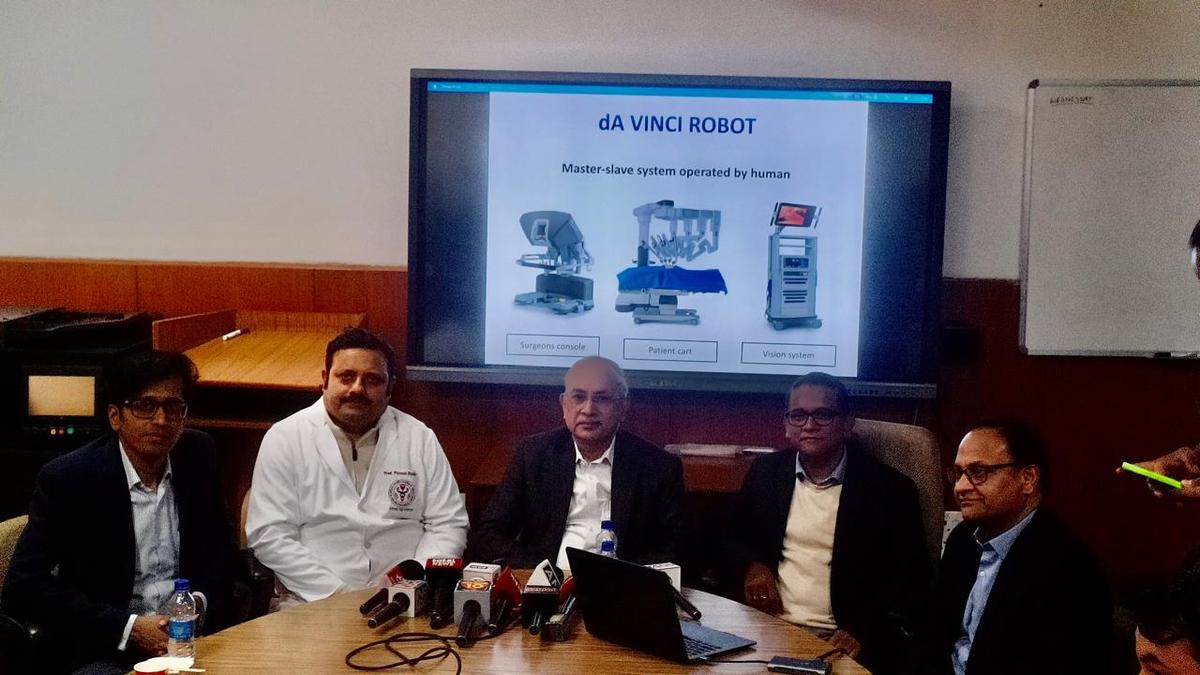
The All India Institute of Medical Sciences has acquired ‘da Vinci robot’ in November 2024.
| Photo Credit: Special arrangement
All India Institute of Medical Sciences (AIIMS), New Delhi, has recently marked a milestone of conducting 1,000 robotic surgeries since November 2024, when the institution acquired the “da Vinci robot”, doctors said on Tuesday.
Stating that the technology can be precise on the parts of the body where accessibility is limited to perform operations on, the Head of the Department of Surgical Disciplines, Professor Sunil Chumber, said, “The surgeries have proven to be minimally invasive and precise, especially in narrow spaces. It reduces the size of the incision and patients recover quicker.”
Dr. Hemanga K. Bhattacharjee, who conducted the first surgery in November 2024, said the machine comprises three sections: a surgeon console, from where the surgeon controls it, a patient cart that has instruments (robotic arms) conducting the surgery, and a vision system from where doctors can get a three-dimensional view of the scenario.
Although several private hospitals across India have deployed many surgical robots, the use of the technology is still in a nascent stage in government hospitals, AIIMS stated in a release.
“The adoption of the surgical robot represents a crucial development in making minimally invasive, highly precise surgeries accessible to a larger population, setting a benchmark for public healthcare in India,” it stated.
According to the statement, the hospital has witnessed 50% reduction in post-operative pain compared to traditional open surgeries, 40% lower rates of surgical site infections, owing to minimal incisions and 30% shorter hospital stays, leading to reduced healthcare costs for patients.
Challenges
Doctors said that while it is 99.9% effective, there are some challenges. The technology cannot be used in some surgeries, particularly trauma and emergency surgeries, which need to be performed immediately, as it takes time to get the machine and necessary equipment ready. Doctors also said that, in rare cases, they might have to switch to a traditional surgery if complications arise.
Published – January 21, 2026 12:43 am IST